

- Certificate of Eligibility For a Status of Residence
- Permission to Extend Period of Stay
- Permission for Permanent Residence
- Other cases / Information
- Profiles
- Consulting for individuals and companies
- Permanent Residence or Permanent Residency
- FAQ
- METHOD
- FEE
- Asahi Shin Nihon Certified Administrative Procedures Legal Specialist
Visa Immigration specialist Japan /
Asahi Shin Nihon Gyoseishoshi Office
We are Japanese Gyoseishoshi Certified Administrative Procedures Legal Specialist, especially about Visa, Immigration Control Act, and so on in Japan.
Status of Residence, Alien Registration, Housing, Schools, Employment, Marriage, Legal Issues, Foreign Nationals.
You do not need to go to the Immigration Bureau in principle from now on, if you ask us.
*Notice
We specialize in marriage visas, spouse visas, international marriages, international marriage procedures, special permission for residence, nationality, loss of nationality, naturalization, and short-term stay visas for girlfriends/boyfriends. Please contact us for any of these related procedures. However, when you call, please ask your Japanese spouse or Japanese fiancé to speak with our firm. This is because these procedures require the cooperation of your Japanese partner.
*Legal Counsel
We are a consulting firm specializing in immigration and at the same time a legal firm. The following is an explanation of basic cases of consultation, but only a small part of our services. For more details, please refer to the Japanese version of this page. The consulting we provide includes appropriate solutions. Please utilize us as your legal consulting firm.
Certificate of Eligibility For a Status of Residence
If a foreigner has this certificate before entrance into Japan beforehand, the period of issuance of a visa can be shortened.
Permission to Engage in an Activity Other Than That Permitted by the Status of Residence Previously Granted
For example, it is related when a pastor is going to teach a foreign language in a linguistic school.
Permission to Change Status of Residence
It is related when a foreigner desires to cease his present activity and is going to concentrate on an altogether new activity which falls outside those permitted by his Status of Residence.
Permission to Extend Period of Stay
If a foreign national desires to remain in Japan under the same status of residence beyond his authorized period of stay,it is necessary to apply for and obtain an extension of period of stay.
Permission for Permanent Residence
Permanent residence is permitted only when a foreign national has established a permanent base of livelihood and when it is deemed that his permanent residence will be in accord with the interests of Japan.
Other cases / Information
Permission to Acquire Status of Residence
This is related to a foreign national who is to stay in Japan without getting through the procedures for landing (e.g.,in case of birth in Japan, renouncement or loss of Japanese nationality).
Re-entry Permission
If you leave Japan without obtaining a re-entry permission beforehand, it is necessary to obtain a visa newly. Therefore it takes more time. Then, this is permission for re-entering quickly.
Alien Registration
All foreign nationals residing in Japan are required to register at the municipal office of the city, ward, town or village, in which they are living. This must be done within a certain amount of time from the day of their arrival in Japan.
Re-entry Permission
If you leave Japan without obtaining a re-entry permission beforehand, it is necessary to obtain a visa newly. Therefore it takes more time. Then, this is permission for re-entering quickly.
Consultation
And, the fundamental examples of consultation are explained.
The following is a part. Also, our consultations involve proper solutions. Please utilize as a legal adviser.
The above are some examples. Another procedure, for example, is “Certificate of authorized employment.” If required for potential employment opportunities, a foreign national authorized to work in Japan may apply for issuance of certificate showing the types of activities, authorized to him, at the Regional Immigration Bureau, etc.
* The way a foreigner enters Japan
* Procedure when entering Japan
* How to reside
* Deportation
* How to change Status of Residence
* Special Permission for Residence
* Period of stay for Special-Residence -permission holders
* Refugee Recognition Status
* Procedures for Recognition of Refugee Status
* Effects of Refugee Status
* Permanent Residence Status
* Naturalization
* Procedures for Naturalization
* Alien Registration
* Application for Confirmation of Registered Items
* Carrying Alien Registration Certificate with you at all times
* Loss of your Alien Registration Certificate
* Damage of your Alien Registration Certificate
* Amendment of Alien Registration Law
* When your work differs from the Contract Agreement
* Registration of Marriage, Birth and Change of Address
* Divorce by Consent Between Foreign Nationals
* Divorce and Child
* Recognition of Child
* Effect of a criminal conviction on Status of Residence
* Structure of the Government
Countries
Ukraine, Poland, Romania, Belarus, Russia, The Philippines, the Kingdom of Thailand, China, Pakistan, Bangladesh, Sri Lanka, Nepal, Myanmar, Korea, Taiwan, India, Indonesia, Malaysia, Mongolia, Brazil, the United States, U.S., Canada, the United Kingdom, U.K., Britain, England, French Republic, Germany, Italia, Spain, Australia, Chile, Peru, Bolivia, United Mexican States, Colombia, etc.
Profiles
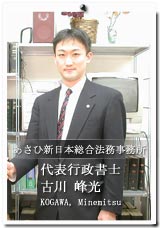
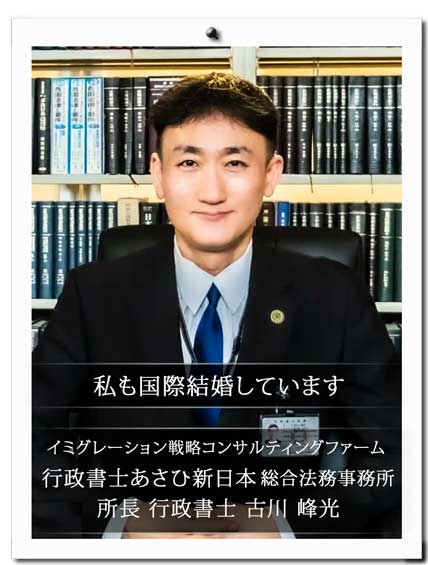
Manager of the office is Minemitsu Kogawa (“KOGAWA”=family (last) name , “Minemitsu”=first name)
He is a Japanese and a Certified Administrative Procedures Legal Specialist who grew up in Tokyo, Japan.
He graduated from the Department of politics and economics at the Waseda University which is positioned as the first ranking in Japan.
His occupations are a Certified Administrative Procedures Legal Specialist and a certified-by-government specialist about management of apartments .
The licenses which he has passed now are
(1) the Certified Administrative Procedures Legal Specialist,
(2) the certified-by-government Specialist about Management of Apartments ,
(3) the Real Estate Sales Person ,
(4) the Welfare and Housing Specialist, and
(5)”The Japan Business Law Examination” by Tokyo Chamber of Commerce and Industry ,which is an examination of the capability of the Certified Administrative Procedures Legal Specialists who are doing business of legal affairs, he has the score of the 1st ranking in Japan in 3531 persons.
(6)And also he has some language licenses, etc..
Totally, he has 15 licences.
Furthermore, using such capability, he has experiences in which he educated students about law, such as students in the Department of Law at the University of Tokyo and the Keio University,etc.. Moreover, he has experiences in which he taught the employees of the judicial-affairs section of companies about the knowledge of judicial affairs.
The fields which he is taking charge of in this office are the following (foreigners, employment, etc.).
Immigration Control Act
Procedures For Entry
Procedures For Staying
Alien Registration
Nationality
Mixed Marriage
International Private Law
KOGAWA, Minemitsu (Director)
Certified Administrative Procedures Legal Specialist
Q: What Business is performed in this office?
A: Consultant, about administrative and legal affairs, centering on immigration.
Especially we deal with employment of a foreigner and the problems of families, such as an mixed marriage.
Moreover, we also support a foreign company when it carries out business in Japan (finding a business partner in Japan , etc.).
*Information*
We are looking for specialists, the investors, etc., in order to carry out business tie-up and management of our office.
Consulting for individuals and companies
1. Foreigners
Dear Sir/Madam:
This office offers many law business centering on the legal rights of foreigners. In this field, there are few specialists in Japan. Moreover, even if there is a specialist, since he demands too much money, a foreigner cannot consult him freely. Then, this office is popular as a law office which is easy to use. Please consult us on every trouble. This office is authorized by the Japanese government. Your privacy is protected. We have protected very carefully the information of an individual or a company .
We are waiting for your early reply.
Yours faithfully,
Minemitsu KOGAWA (Asahi Shin Nihon Certified Administrative Procedures Legal Specialist Office)
2. Companies
Dear Sir/Madam:
A complicated procedure is required when a company employs a foreigner. However, each company has to cut down its cost. Then, this office manages employment of a foreigner etc.,instead of your company. Unlike a Japanese employee, the law problem about a foreigner requires special consideration.
Please see “EXAMPLES” on Top Page about this.
Moreover, about these points, the foreigner who was not able to be employed can also be employed now because of a legal revision(e.g.the engineer of computer). So, please utilize this office as a special legal adviser for employing a foreigner to become more advantageous than other companies.
If an Legal Adviser Contract is concluded, you will be quickly told about the information on the newest and useful employment. Consequently, your company can also manage employment appropriately.
In this office, legal knowledge and the quantity of experience differ from other offices. For example, the representative of this office has passed many legal qualifications which the Japanese government has authorized. So, suitable advice is possible. Moreover, in “The Japan Business Law Examination” by Tokyo Chamber of Commerce and Industry ,which is an examination of the capability of the Certified Administrative Procedures Legal Specialists who are doing business of legal affairs, the representative of this office has the score of the 1st ranking in Japan in 3531 persons.
Furthermore, using such capability, the representative of this office has experiences in which he educated students about law, such as students in the Department of Law at the University of Tokyo and the Keio University,etc.. Moreover, he has experiences in which he taught the employees of the judicial-affairs section of companies about the knowledge of judicial affairs.
Furthermore, as it is in this English page, in this office, it is also wonderful that our service can be offered in English.
And in this office, business with high quality in this way is offered, and, moreover, the fee is reasonable.
From now on, this office will offer more legal business.
Please ask us at this opportunity.
Please commission us to take the necessary procedure for Visa Application.
We are waiting for your early reply.
Yours faithfully,
Minemitsu KOGAWA (Asahi Shin Nihon Certified Administrative Procedures Legal Specialist Office)
3. Social meaning of this office
Now, Japan is in a very severe situation. This office is managed in order to overcome this critical situation. We believe that activity of this office will be useful for Japan and the world.
Permanent Residence or Permanent Residency
By native Japanese immigration visa passport Certified Administrative Procedures Legal Specialists in Asahi Shin Nihon Certified Administrative Procedures Legal Specialist Office (firm)
Q: Are we required to know Japanese language ?
A: Yes, you are. For example, almost all the documents are required to be made in Japanese.
And you have to go to Immigration Bureau, when the officers talk to you in Japanese in order to confirm your ability of language skill, etc.
And you have to write a kind of your explanation letter for permanent
residence only in Japanese.
However, you can apply for permanent residence according to our advice and support.
And we can go and apply for permanent residence instead of yourself.
So, you need not go to the bureau if you ask me.
In order to get permanent residence in Japan, what is needed?
Can I have permanent residence in Japan? There are many such inquiries evryday in our law office.
In fact, the requirements for permanent residence are not necessarily fixed.
There are some exceptional cases also in this permanent residency or a permanent residence application.
Permanent residence in Japan. The reasons should differ one by one.
However, if there is no permanent residency, you will become always uneasy by the renewal of the period of Japanese visa. There is no guarantee to which renewal of Japanese visa is permitted.
Moreover, in practice, when a bank also lends money, it thinks as important whether you have a permanent residency in Japan.
This is a proof with the unstable legal status of a foreigner in case he/she has no permanent residence status in Japan.
Is the application procedure of permanent residence in Japan also difficult?
This also will differ one by one. Even if you are good at Japanese, you will go to various public offices here and there repeatedly after all in Japan. Documents for permanent residence will also be rewritten repeatedly.
It may spend about one month. You will worry also about how to write a statement of reasons for permanent residence. You may translate documents without the necessity of translating and may give a translation company useless remuneration. It is an error if you think that a lot of documents should be submitted. But also it is improper for them to be too few.
It is important to draw up required and sufficient documents.
When we make a permanent residence application, the data for pros, the trend of Japanese precedent information and the Japanese authorities, etc. are synthesized, and documents are drawn up.
And we have the data which we asked directly to the former Director General of Immigration Bureau in Japan.
In a permanent residence application in Japan, required documents are specified once.
However, there are various other documents which can be used in fact.
Moreover, it is inadequate to submit only the specified documents.
Only the Japanese Certified Administrative Procedures Legal Specialists for the Immigration Bureau know such things.
Moreover, when we treat the application of permanent residence, the knowledge and experience of other Status of Residence can be useful.
When a permanent residence application was made and it became a disapproval—-
Please do not resign yourself. Please consult immediately. There are remedies.
However, the aid may be unable to be given, when there is a fatal flaw which cannot recover easily in a first-time application.
Then, we will recommend you to ask us from the beginning.
To: the clients who would like to want Japanese permanent residence in Japan.
The permanent resident -specialist of this office will guide you in the Immigration Bureau.
We will support the negotiation between our clients and the Immigration Bureau about permanent residence application.
FAQ
Overstay etc.
Recently, there are many consultations from foreign nationals about overstay in Japan which require our professional help. We are good at that kind of procedure. Please ask us about that.
Inquiries are increasing from business firms. Quick and adequate management judgment is important for business. I recommend you our Legal Adviser Contract so that you could respond to as soon as a legal revision is enacted.
Since this office has been registered on many search engines (mainly English) in the world, all whole-world population is to be our CLIENT. In the inquiry sent recently from overseas companies,we think it seems that they would like to seek for “Business Partner” in Japan.
We are now seeking for talented people who are good at international judicial affairs as our employees because this office has become busy. However, this work cannot be managed, unless you have full knowledge of the both sides of laws in Japan and foreign laws, and of Japanese + English. Especially, Civil Law, Commercial Law, Immigration Control Act, International Private Law, and English are required. If you would like to work in this office, please mail your resume. We will reply only to appropriate persons.
In addition, your resume will not be returned because a lot of applications are sent to us.
Q1:What should I do when I desire to enter Japan?
A1: You must have your passport to be issued by the government first of all.
And then, according to the purpose of your entering Japan, you should have a proper visa issued by Japanese embassy etc.
Q2:What kind of procedures are required when I have arrived at Japan?
A2:When you arrive at Japan, you are to be examined by the officers in the immigration bureau.
Then, you will have your passport stamped with “landing permission.”
The conditions to landing permission are below.
* Valid passport
* In principle, your visa should have been stamped on your passport.
* Your purpose of entering Japan is proper for the staus of residence in Japan.
* That you do not fall within any one of the reasons for Denial of Landing.
***Any alien who falls within any one of the following items shall be denied permission for landing in Japan:
(1) A patient who falls in any of the following categories of the infections, which are provided for by the Law Concerning Prevention of Infections and Medical Care for Patients of Infections (Law No.114, 1998); category 1 or category 2 infections or designated infections (in respect of the infections to which the provisions of Article 19 or 20 of the Act shall apply, in accordance with the Cabinet Order under the provisions of Article 7 of the Act) including a person who is regarded as a patient of category 1 or category 2 infections or designated infections under the provisions of Article 8 of the Act, or any person who has symptoms of new infections;
(2) Any person who is mentally defective as prescribed by the Law Concerning Mental Health And Welfare For The Mentally Disabled (Law No.123 of 1950);
(3) Any person who is a pauper, vagrant, etc., and is likely to become a burden on the Japanese Government or a local public entity because of inability to make a living;
(4) Any person who has been convicted of a violation of any law or regulation of Japan, or of any other country, and sentenced to penal servitude or imprisonment for 1 year or more, or to a penalty equivalent thereto except for those convicted of a political offense;
(5) Any person who has been convicted of a violation of any law or regulation of Japan or of any other country relating to control of narcotics, marijuana, opium, stimulants or psychotropic substances and sentenced to a penalty;
(5)-2 Any person who has been convicted of a violation of any law or regulation of Japan or of any other country or has been deported from Japan in accordance with the provision of the Immigration Control and Refugee Recognition Act or expelled from any other country in accordance with the provision of any law or regulation of that country for killing, injuring, assaulting or threatening a person, or damaging or destroying a building or other thing in relation to the process or result of an international-scale competition or a competition of the equivalent scale or an international-scale conference (hereinafter referred to as “international competition, etc.”)or with intent to prevent smooth operation thereof, and is likely to kill, injure, assault or threaten a person, or damage or destroy a building or other thing in relation to the process or result of an international competition, etc. held in Japan or with intent to prevent the smooth operation thereof, at the venue of the international competition, etc. or within the area of a municipality where the venue is located (This refers to “ward” where Tokyo Special Wards exist or for cities designated in Article 252-19, Paragraph 1 of the Local Autonomy Law (Law No.67 of 1947).) or in a neighboring place provided for use by unspecified or many people;
(6) Any person who illegally possesses any narcotics or psychotropic substances as provided for by the Narcotics and Psychotropic Substances Control Law (Law No.14 of 1953), or marijuana as provided for by the Marijuana Control Law (Law No.124 of 1948), or poppy, opium or poppy plant as provided for by the Opium Law (Law No.71 of 1954), or stimulants or raw materials used for stimulants as provided for by the Stimulants Control Law (Law No.252 of 1951), or any other paraphernalia used for smoking or eating opium;
(7) Any person who engages or has engaged in prostitution, or procuring prostitutes for other persons or solicitation or furnishing a place for prostitution, or any other business directly connected with prostitution;
(8) Any person who illegally possesses firearms or swords, etc. provided for by the Law for Controlling the Possession, etc. of Firearms, Swords, etc. (Law No.6 of 1958) or explosives provided for by the Explosives Control Law (Law No.149 of 1950);
(9) Any person who has been denied landing for coming under the provision of either Item (6)or the preceding item and 1 year has not yet elapsed from the date of the denial, or any alien who has been deported from Japan for coming under any one of the items of Article 24 (except for Item (4), Sub-items (1) to (o) and Item (4)-3) and 5 years has not elapsed from the date of the deportation;
(9)-2 Any person who has been pronounced a sentence of penal servitude or imprisonment on the charge of a crime referred to in Book II, Chapters XII, XVI to XIX, XXIII, XXVI, XXVII, XXXI, XXXIII, XXXVI, XXXVII or XXXIX of the Penal Code of Japan (Law No. 45 of 1907), or in Article 1, 1-2 or 1-3 (except for the parts concerning Article 222 or 261 of the Penal Code of Japan) of the Law concerning Punishment of Physical Violence and Others (Law No. 60 of 1926), or in the Law for Prevention and Disposition of Robbery, Theft, etc. (Law No. 9 of 1930) during a stay in Japan with the status of residence described in the upper column of the Annexed Table I, and who has left Japan after that, and the judgement has become final when the person is outside of Japan, and five years have not yet elapsed from the date when the judgement became final;
(10) Any person who has been deported from Japan for coming under any one of Article 24, Item (4), Sub-items (1) to (o);
(11) Any person who attempts or advocates the overthrow of the Constitution of Japan or the Government formed thereunder by means of force or violence, or who organizes or is a member of a political party or any organization which attempts or advocates the same;
(12) Any person who organizes, or is a member of, or is closely affiliated with any of the following political parties or organizations:
Any political party or organization that encourages acts of violence or assaulting, killing, or injuring of officials of the Government
or local public entities for the reason of their being such officials;
Any political party or organization that encourages the illegal damage or destruction of public installations or facilities;
Any political party or organization that encourages an act of dispute such as stopping or preventing normal maintenance or operation of security equipment of a plant or place of work.
(13) Any person who attempts to prepare, distribute, or display printed matters, motion pictures, or any other documents or drawings to attain the objectives of any political party or organization provided for in Item (11) or the preceding item;
(14) Any person except those coming under the preceding items who the Minister of Justice has reasonable grounds to believe is likely to commit an act which could be detrimental to the interests or public security of Japan.
Q3:What qualifications are required to reside in Japan?
A3:
(1)
| Status of Residence | Activities authorized to engage in |
| Diplomat | Activities on the part of constituent members of diplomatic missions or consular offices of foreign governments hosted by the Japanese Government; activities on the part of those who are provided with similar privileges and/or immunities as are granted to diplomatic missions in accordance with treaties or international customary practices; and activities on the part of their family members belonging to the same household. |
| Official | Activities on the part of those who engage in the official business of foreign governments or international organizations recognized by the Japanese Government; and activities on the part of their family members belonging to the same household (excluding the activities described in this table’s “Diplomat” column). |
| Professor | Activities for research, direction of research or education at colleges, equivalent educational institutions or “Kotosenmongakko”. |
| Artist | Activities for the arts that provide income, including music, the fine arts, literature, etc.(excluding the activities described in the “Entertainer” column of Table (2)). |
| Religious | Missionary and other religious activities conducted by foreign religionists |
| Activities | dispatched by foreign religious organizations. |
| Journalist | News coverage and other journalistic activities conducted on the basis of a contract with foreign journalistic organizations. |
(2)
| Status of Residence | Activities authorized to engage in |
| Investor/Business Manager |
Activities to commence the operation of international trade or other business, to invest in international trade or other business and to operate or manage that business, or to operate or manage international trade or other business on behalf of the foreign nationals (including the foreign corporations; hereinafter in this section foreign national is to include foreign corporation) who have begun such an operation or have invested in such a business (excluding the activities to engage in the operation or management of the business which are not allowed without the legal qualifications described in this table’s “Legal/Accounting Services” column). |
| Legal/Accounting Services |
Activities to engage in the legal or accounting business, which is required to be carried out by “GaikokuhoJimubengoshi”, “Gaikokukoninkaikeishi” or those with other legal qualifications. |
| Medical Services | Activities to engage in medical treatment services, which are required to be undertaken by physicians, dentists or those with other legal qualifications. |
| Researcher | Activities to engage in research on the basis of a contract with public or private organizations in Japan (excluding the activities described in the Professor column of Table (1)). |
| Instructor | Activities to engage in language instruction and other education at elementary schools, lower secondary schools, upper secondary schools, secondary educational schools (“Chutokyoikugakko”), special schools for the visually impaired, handicapped children’s schools, advanced vocational schools (“Senshugakko”), vocational schools (“Kakushugakko”) or the other educational institutions equivalent to vocational schools in facilities and curriculum. |
| Engineer | Activities to engage in services, which require technology and/or knowledge pertinent to physical science, engineering or other natural science fields, on the basis of a contract with public or private organizations in Japan (excluding the activities under “Professor” column of Table (1) and excluding the activities described in the “Investor/Business Manager”, “Medical Services”, “Researcher”, “Instructor”, “Intra-company Transferee” and “Entertainer” columns of this Table). |
| Specialist in Humanities/Inter- national Services |
Activities to engage in services, which require knowledge pertinent to jurisprudence, economics, sociology or other human science fields or to engage in services which require specific ways of thought or sensitivity based on experience with foreign culture, based on a contract with public or private organizations in Japan(excluding the activities described in the “Professor”, “Artist” and “Journalist” columns of Table(1)and excluding the activities described in the “Investor/Business Manager”, “Legal/Accounting Services”, “Medical Services”, “Researcher”, “Instructor”, “Intra-company Transferee” and “Entertainer” columns of this Table). |
| Intra-company Transferee |
Activities on the part of personnel who are transferred to business offices in Japan for a limited period of time from business offices which are established in foreign countries by public or private organizations which have head offices, branch offices or other business offices in Japan and who engage at these business offices in the activities described in the “Engineer” or “Specialist in Humanities/International Services” column of this Table. |
| Entertainer | Activities to engage in theatrical performances, musical performances, sports or any other show business (excluding the activities described in the “Investor/Business Manager” column of this Table). |
| Skilled Labor | Activities to engage in services, which require industrial techniques or skills belonging to special fields on the basis of a contract with public or private organizations in Japan. |
| Status of Residence | Activities authorized to engage in |
| Cultural Activities | Academic or artistic activities that provide no income, or activities for the purpose of pursuing specific studies on Japanese culture or arts, or activities for the purpose of learning and acquiring Japanese culture or arts under the guidance of experts (excluding the activities described in the columns from “College Student” to “Trainee” in Table(4)). |
| Temporary Visitor | Sightseeing, recreation, sports, visiting relatives, going on inspection tours, participating in lectures or meetings, business contact or other similar activities during a short period of stay in Japan. |
- (4)
| Status of Residence | Activities authorized to engage in |
| College Student | Activities to receive education at colleges or equivalent educational institutions, specialized courses of study at advanced vocational schools (“Senshugakko”), educational institutions designated for preparing persons who have completed 12 years of education at schools in foreign countries to enter college, or “Kotosenmongakko”. |
| Pre-college Student |
Activities to receive education at high schools(excluding the latter courses of secondary educational schools(“Chutokyoikugakko”)), high school courses of special schools for the visually impaired or of handicapped children’s schools, higher or general courses of advanced vocational schools (“Senshugakko”), or vocational schools (“Kakushugakko”) (excluding the educational institution described in the “College Student” column of this table)or other educational institutions which are equivalent to vocational schools in facilities and curriculum. |
| Trainee | Activities to learn and acquire the technology, skills or knowledge at public or private organizations in Japan(excluding the activities described in the “College Student” and “Pre-college Student” columns of this Table). |
| Dependent | Daily activities on the part of the spouse or unmarried minor child of those who stay in Japan with the status of residence mentioned in Tables (1), (2) or (3) (excluding “Diplomat”,” Official” and “Temporary Visitor”) or of those who stay with the status of residence of “College”, “Pre-college” or “Trainee” in this Table. |
| Status of Residence | Activities authorized to engage in |
| Designated Activities |
Activities which are specifically designated by the Minister of Justice for foreign individuals. |
| Status of Residence | Personal relationship or status on which the residence is authorized |
| Permanent Resident |
Those who are permitted permanent residence by the Minister of Justice. |
| Spouse or Child of Japanese National |
The spouses of Japanese nationals, the children adopted by Japanese nationals in accordance with the provisions of Article 817-2 of the Civil Code(Law No.89 of 1896)or those born as the children of Japanese nationals. |
| Spouse or Child of Permanent Resident |
The spouses of those who stay with the status of residence of “Permanent Resident” or Special Permanent Resident(hereinafter referred to as “permanent resident etc.”), those born as children of a permanent resident etc. in Japan and having been residing in Japan. |
| Long Term Resident |
The spouses of those who stay with the status of residence of “Permanent Resident” or Special Permanent Resident(hereinafter referred to as “permanent resident etc.”), those born as children of a permanent resident etc. in Japan and having been residing in Japan. |
Q4:Under what circumstances are foreigners to be deported from Japan?
A4:Any alien who comes under any one of the following items may be deported from Japan in accordance with the procedures provided for in the following chapter:
(1) Any person who has entered Japan in violation of the provision of Article 3;
(2) Any person who has landed in Japan without obtaining landing permission, etc. from an Immigration Inspector ;
(3) Any person who has forged or altered a document or drawing, has prepared a false document or drawing, or has used, possessed, transferred or lent a forged or altered document or drawing or false document or drawing, or has arranged the transfer or lending thereof with the intent of helping another alien to illegally receive an issue of a certificate, a stamp of permission for landing or permission in accordance with the provision of Chapter III, Section I or II, permission for landing in accordance with the provision of Chapter III, Section IV or permission in accordance with the provision of Chapter IV, Section I or Chapter V, Section III;
(4) Any alien in Japan (except for those to whom permission for provisional landing, permission for landing at port of call, permission for landing in transit, landing permission for crewman, or landing permission due to disaster has been granted) who comes under any one of the following sub-items:
Any person who is clearly found to be engaged solely in activities involving the management of a business involving income or activities for which he receives remuneration in violation of the provisions of Article 19, Paragraph 1;
Any person who stays in Japan beyond the period of stay authorized without obtaining an extension or change thereof;
Any person who has been punished for violation of the provisions of Article 74 to 74(6), or 74(8);
Any person who has been sentenced to imprisonment or a heavier penalty for violation of the provision of laws and ordinances relating to the alien registration except for those who have been sentenced guilty with suspension of execution of the sentence;
Any person who is a juvenile provided for by the Juvenile Law (Law No.168 of 1948) and who has been sentenced after November 1, 1951, to penal servitude or imprisonment of not less than 3 years;
Any person who has been convicted later than November 1, 1951, for the violation of a provision of the Narcotics and Psychotropic Substances Control Law, Marijuana Control Law, Opium Law, Stimulants Control Law, Law Concerning Special Provisions for the Narcotics and Psychotropics Control Law, etc. and Other Matters for the Prevention of Activities Encouraging Illicit Conducts and Other Activities Involving Controlled Substances through International Cooperation (Law No.94 of 1991) or Book II, Chapter ?o]IV of the Penal Code (Law No.45 of 1907);
Except for those under Sub-items(e) to (h), any person who has been punished after November 1, 1951, with penal servitude or imprisonment for life or for a period of not less than 1 year. However, this shall not apply to those sentenced guilty with suspension of execution of the sentence;
Any person who is engaged in prostitution or procuring prostitutes for others, solicitation, furnishing of the place for prostitution, or any other business directly connected with prostitution;
Any person who has incited, instigated, or aided the illegal entry or illegal landing of an alien into Japan;
Any person who attempts or advocates the overthrow of the Constitution of Japan or the Government formed thereunder by means of force or violence, or who organizes or is a member of a political party or any other organization which attempts or advocates the same;
Any person who organizes, or is a member of, or is closely associated or affiliated with any of the following political parties or other organizations:
1) Any political party or organization that encourages acts of violence or assaulting, killing, or injuring officials of the Government or local public entities for the reason of their being such officials;
2) Any political party or organization that encourages illegal damage or destruction of public installations or facilities;
3) Any political party or organization that encourages an act of dispute, such as, stopping or preventing normal maintenance or operation of security equipment of a plant or a place of work.
Any person who has prepared, distributed or displayed printed matters, motion pictures, or any other documents or drawings to attain the objectives of any political party or organization provided for in Subitem (1) or (m);
Any person except those coming under Subitems (a), (b) and (e) to (n), who the Minister of Justice determines has committed acts detrimental to the interests or security of Japan.
(4)-2 Any person who stays in Japan with the status of residence described in the upper column of the Annexed Table I and has been sentenced to penal servitude or imprisonment on the charge of a crime referred to in Book II, Chapters XII, XVI to XIX, XXIII, XXVI, XXVII, XXXI, XXXIII, XXXVI, XXXVII or XXXIX of the Penal Code of Japan, or in Article 1, 1-2 or 1-3 (except for the parts concerning Article 222 or 261 of the Penal Code of Japan) of the Law concerning Punishment of Physical Violence and Others, or in the Law for Prevention and Disposition of Robbery, Theft, etc;
(4)-3 Any person whose status of residence is Temporary Visitor, and has illegally killed, injured, assaulted or threatened a person, or damaged or destroyed a building or other thing in relation to the process or result of an international competition, etc. held in Japan or with intention to prevent the smooth operation thereof, at the venue of the international competition, etc. or within the area of a municipality where the venue is located (This refers to “ward” where Tokyo Special Wards exist or for cities designated in Article 252-19, Paragraph 1 of the Local Autonomy Law.) or in a neighboring place provided for use by unspecified or many people.
(5) Any person who has been grant permission for a provisional landing and escapes or fails to comply with a summons without justifiable reason in violation of the conditions imposed based on Article 13, Paragraph 3;
(5)-2 Any person who has been ordered to leave Japan based on the provisions of Article 10,Paragraph 10, or Article 11, Paragraph 6 but does not leave without delay.
(6) Any person grant permission for landing at a port of call, permission for landing in transit, landing permission for crewman, permission for emergency landing, landing permission due to disaster or landing permission for temporary refuge who stays in Japan beyond the period entered in his passport or permit;
(6)-2 Any person who has been designated a period based on the provisions of Article 16, Paragraph 7, but does not return to his vessel or leave Japan within that period.
(7) Any person provided for in Article 22-2, Paragraph 1, who stays in Japan beyond the period prescribed in Article 22-2, Paragraph 1, without receiving permission pursuant to the same Article Paragraph 3, applicable correspondingly to Article 20, Paragraphs 3 and 4 or pursuant to Article 22-2, Paragraph 4, applicable correspondingly to Article 22, Paragraphs 2 and 3.
Q5:What kinds of procedures should I take if I need change my Status of Residence?
A5:An alien who has a status of residence may have his status of residence (in the case of an alien residing under the status of residence of Designated Activities, the activities specifically designated by the Minister of Justice in respect of the person concerned are to be regarded as a status of residence) changed (including the period of stay thereon; hereinafter the same in Paragraphs 1 or 3).
Any alien who wishes to have his status of residence changed pursuant to the provision of the preceding paragraph shall apply to the Minister of Justice for the change of status of residence in accordance with the procedures provided for by the Ministry of Justice Ordinance. However, if he desires to change his status of residence to that of Permanent Resident, he shall comply with the procedures provided for in Article 22, Paragraph 1.
When an application for change of status of residence has been submitted, the Minister of Justice may grant permission only when he finds that there are reasonable grounds to grant the change of status of residence on the strength of the documents submitted by the alien. However, in the case of an application submitted by a person whose status of residence is Temporary Visitor, permission shall not be granted unless the application is made based on a special unavoidable circumstances.
When the permission mentioned in the preceding paragraph has been granted, the Minister of Justice shall have an Immigration Inspector enter the new status of residence and period of stay in the passport of the alien if he has a passport in his possession, or issue to the alien a Certificate of Status of Residence with new status of residence and period of stay entered or enter the new status of residence and period of stay in a previously issued Certificate of Status of Residence if he does not possess a passport. In such a case the contents of the pemission will become effective as of the time the entrance or issuance is made.
Q6:Under what circumstances can I be given a Special Permission for Residence?
A6:The Minister of Justice may, even if he finds that the objection filed is groundless in making a decision under Paragraph 3 of the preceding article, grant the suspect special permission to stay in Japan if:
(1) He has obtained permission for permanent residence;
(2) He has had in the past a permanent domicile in Japan as a Japanese national; or
(3) The Minister of Justice finds grounds for granting special permission to stay, other than the previous two subparagraphs.
Q7:I want to know how to get the Permanent Residence Status.
A7:Any alien who seeks to change his status of residence to that of Permanent Resident shall apply to the Minister of Justice for permission of permanent residence in accordance with the procedures provided for by the Ministry of Justice Ordinance.
When the application provided for in the preceding paragraph has been submitted, the Minister of Justice may grant permission only when he deems that the alien conforms to the following items and that his permanent residence will be in accordance with the interests of Japan. However, the following items shall not require conformity in the case of spouses and children of Japanese, those who have Permanent Residence status or those who are Special Permanent Residents described in the Special Law on the Immigration Control of inter alia, Those Who Have Lost Japanese Nationality on the basis of the Treaty of Peace with Japan. (Law No. 71 of 1991, hereinafter referred to as Special Permanent Resident).
(1) The alien’s behavior and conduct must be good;
(2) The alien must have sufficient assets or ability to make an independent living.
Q8:Please tell me about Immigration Inspector’s Examination.
A8:When the application referred to in Paragraph 2 of the preceding article is made, an Immigration Inspector shall conduct an examination of the said alien as to whether or not he meets each of the following conditions for landing in Japan. (In respect to the alien having received re-entry permission under the provisions of Article 26, Paragraph 1 or the Refugee Travel Document under the provisions of Article 61-2-6, Paragraph 1, only the conditions mentioned in the following Items (1) and (4) are to be applied.)
(1) The passport possessed by the alien and the visa affixed thereto, if such is required, must be valid;
(2) Activities to be engaged in Japan stated in the application must not be false, and must fall within one of the activities described in the right-hand column of Annexed TableI, (in respect of the activities described in the right-hand column of Annexed TableI (5), the proposed activities must be activities designated by the Minister of Justice in the Official Gazette), or the activities of a person with the civil status or position described in the right-hand column of Annexed TableII (the civil status or position in the right-hand column under Permanent Resident shall be excluded; in respect of the position specified under Long Term Resident, the proposed position must be one of the positions designated by the Minister of Justice in the Official Gazette), and shall fulfill in respect of those who intend to engage in the activities described in the right-hand column of Annexed TableI (2) and (4) the requirement provided for by the Ministry of Justice Ordinance which shall be stipulated in consideration of factors including but not limited to the effect on Japanese industry and public welfare.
(3) The period of stay applied for must be in accordance with the provisions of the Ministry of Justice Ordinance stipulated under Article 2-2, Paragraph 3;
(4) The alien must not fall within any one of the items of Article 5, Paragraph 1.
The alien subject to the examination provided for in the preceding paragraph shall establish the fact that he meets the landing requirements stipulated therein.
Q9:Please tell me about Certificate of Authorized Employment.
A9:When an application is submitted by an alien residing in Japan, the Minister of Justice may issue a document which certifies the eligibility of the applicant for activities involving the management of a business involving income or activities for which he receives remuneration in accordance with the provisions of the Ministry of Justice Ordinance.
No one shall discriminate in employing, etc. an alien for failure to show or submit the certificate mentioned in the preceding paragraph, when it is evident that the person concerned is authorized to engaged in the activities involving the management of a business involving the income or activities for which he receives remuneration.
Q10:What kinds of procedures should I take if I need to extend my Period of Stay?
A10:Any alien residing in Japan may, without changing his status of residence, have his period of stay extended.
Any alien who wishes to extend his period of stay pursuant to the provision of the preceding paragraph shall apply to the Minister of Justice for the extension of such period in accordance with the procedures provided for by the Ministry of Justice Ordinance.
When the application provided for in the preceding paragraph has been submitted, the Minister of Justice may grant permission only when there are reasonable grounds to grant the extension of the period of stay on the strength of documents submitted by the alien.
When the permission provided for in the preceding paragraph has been granted, the Minister of Justice shall have an Immigration Inspector enter the new period of stay in the passport of the alien if he has a passport in his possession, or issue to the alien a Certificate of Status of Residence with status of residence and new period of stay entered or enter the new period of stay in a previously issued Certificate of Status of Residence if he does not possess a passport. In such a case the provisions of the last sentence of Paragraph 4 of the preceding article, shall apply mutatis mutandis.
This office is a full-scale office by the specialist, whose licenses contain “The Japan Business Law Examination” by Tokyo Chamber of Commerce and Industry ,which is an examination of the capability of the legal specialists who are doing business of legal affairs, he has the score of the 1st ranking in Japan in 3531 persons.
We are waiting for your early reply.
METHOD
How to consult Certified Administrative Procedures Legal Specialist
The following explanation is designed for a typical administrative procedure,etc.. Since it changes with contents of a consultation, please ask beforehand.
Also, if you are interested in the “Legal Adviser Contract” which is a continuous contract, then please ask us.
1. Application for our office
The details of your application are checked in this office by E-mail, “Inquiry (Form)”, mail, or telephone.
2. Undertaking of the application
Then, when we undertake the application, we will notify you of that.
3. The time when our works start.
Our business for your application will be start from the time of your paying our fee.
4. Completion of business
The time when the purpose of the contract concerned is attained.
5. Your expenses other than our fee
These are not our fee.
For example, please pay the following. (1) The various charges paid to the government. (2) The bank-transfer-charge to our bank account. (3) Transportation expenses. (4) The charge for stamps paid to the government. (5) Translation of a foreign language document etc.
And also, please prepare and pay them, before we begin each business.
6. The due date for payment of remuneration
You need pay in advance.
7. Cancellation
When canceling the business for the sake of your convenience, your paid deposit money will be given to our office as the cancellation fee.
8. Appointment for the consultation when meeting directly
This office has adopted the appointment system. When you come directly, please be sure to appoint.
9. Best Effort
Our office adopts Best Effort service. Namely, we do not guarantee any result such as permission. This is a standard in Japanese Immigration Certified Administrative Procedures Legal Specialists.
10. Time Charge
4800 Yen per 30 minute in our Asahi Shin Nihon Certified Administrative Procedures Legal Specialist Office.
11. The Consultation
: 19200 Yen (120 minutes)
: 160 Yen per 1minutes.
Please also pay these in advance.
Civil law of Japan
When you consult us, free of charge, in E-mail or “inquiry form” etc., this office does not take the Legal Responsibility about the result caused by our that reply, because that is only “donation.” This is specified in the Article 551 of Civil law of Japan. Therefore, this is applied to other offices. This means that FREE (of charge) consultation has its limit in order to give the suitable information to paid clients. So, this Article 551 of Civil Law is applied also to the articles written on this homepage free of charge.
FEE
These are some samples as a general rule.
Please ask about the consultations other than the following.
1. International judicial affairs, International Private Law, Foreigner, The Procedure of Status of Residence, Naturalization, Permanent Residence, Establishment of Company in Japan by Foreign Corporation, etc.
2. Commercial law, Establishment of a company.
3. The law for people , Contract, Contents-certified mail, etc.
4. Legal adviser contract
5. Consultation by Email,mail, or “inquiry form”
6. The Consultation when meeting directly
7. (1) The various charges paid to the government. (2) The bank-transfer-charge to our bank account. (3) Transportation expenses. (4) The charge for a stamp paid to the government. (5) Translation of a foreign language document etc.
8. The lecturer of a lecture and training
9. Estimate
Details
1. International judicial affairs, International Private Law, Foreigner, The Procedure of Status of Residence, Naturalization, Permanent Residence, Establishment of Company in Japan by Foreign Corporation, etc.
1-a The application for permission of naturalization.
Generally speaking, around 50000 Yen to 500000 Yen.
1-b Application for Certificate of Eligibility for a Status of Residence
1-b-a (Investor/Business Manager)
Generally speaking, around 50000 Yen to 500000 Yen.
1-b-b (Specialist in Humanities/International Services)
Generally speaking, around 50000 Yen to 500000 Yen.
1-b-c (Skilled Labor) For example, when you invite a cook to Japan.
Generally speaking, around 50000 Yen to 500000 Yen.
1-b-d (Spouse of Japanese National)
Generally speaking, around 50000 Yen to 500000 Yen.
1-c Application for Permission for Permanent Residence
Generally speaking, around 50000 Yen to 500000 Yen.
1-f Special Permission for Residence
Generally speaking, around 50000 Yen to 500000 Yen.
1-g Temporary Visitor
Generally speaking, around 50000 Yen to 500000 Yen.
1-h Establishment of Company in Japan by Foreign Corporation
Generally speaking, around 500000 Yen to 1000000 Yen.
2. Commercial law, Establishment of a company.
(These are only some examples of our many works.)
2-a Documents to establish a joint-stock corporation.
Generally speaking, around 200000 Yen to 500000 Yen.
2-b Documents to establish a (limited) corporation.
Generally speaking, around 200000 Yen to 500000 Yen.
2-c Office Regulations.
Generally speaking, around 100000 Yen to 500000 Yen.
3. The law for people, Contract, Contents-certified mail, etc.
(These are only some examples of our many works.)
3-a Contents-Certified Mail
Generally speaking, around 50000 Yen to 500000 Yen.
3-b Documents of Contract
Generally speaking, around 100000 Yen to 500000 Yen.
3-c Letter of Complaint
Generally speaking, around 100000 Yen to 500000 Yen.
4. Legal adviser contract
(These are only some examples of our many works.)
The Legal Adviser Contract for providing you with the information for employment of foreigners.
Generally speaking, around 10000 Yen to 500000 Yen.
5 Consultation by Email,mail,or “inquiry form”
: 30000 Yen (120 minutes) “at least”
Please also pay these in advance.
6. The Consultation when meeting directly
: 30000 Yen (120 minutes) “at least”
Please also pay these in advance.
7 (1) The various charges paid to the government. (2) The bank-transfer-charge to our bank account. (3) Transportation expenses. (4) The charge for a stamp paid to the government. (5) Translation of a foreign language document etc.
Please pay beforehand.
8. The lecturer of a lecture and training
It is 99800 Yen for every hour. This office has had many experiences of the lecturer who teaches 100 persons about with a microphone used.
9. Estimate
It is free of charge. Please ask us.
Asahi Shin Nihon Certified Administrative Procedures Legal Specialist
行政書士あさひ新日本総合法務事務所/Visa Immigration specialist Japan / Asahi Shin Nihon Gyoseishoshi Office
We are the Immigration Specialists in Japan.
Postal code number 344-0038
ADDRESS
1F, 4-1, Onuma, Kasukabe City, Saitama Prefecture, (344-0038), Japan (prior booking essential)
Inquiry:mailform, e-mail, Tel.